Ursus mistakes Hardquanonne’s burial for Gwynplaine’s
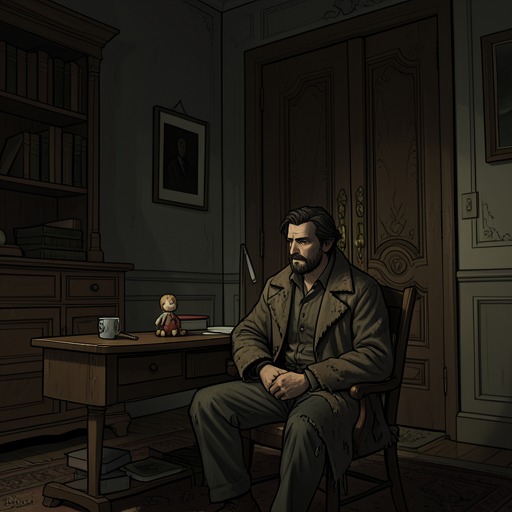
The Man Who LaughsUrsus mistakes Hardquanonne’s burial for Gwynplaine’s and is overwhelmed by grief for the son he believes has been killed. The episode turns a handful of ambiguous signs into apparent certainty: a prison bell, a torchlit procession, and a coffin entering the cemetery. The reader is told that the dead man is Hardquanonne, but Ursus cannot know this, and his mistaken conclusion shapes the night that follows.
The prison gate and the funeral
Ursus hears the prison bell tolling in the darkness and tries to keep his thoughts from sliding into conjecture. He looks toward the place where he knows the prison gate to be. A redness appears in the dark, enlarges into a light, and reveals the gate turning open on its hinges. The narration renders the entrance as a yawning rather than an opening, giving the prison’s release of its occupants an ominous, almost bodily quality.
A man carrying a torch passes through the gate. Ursus watches both the torch and the continuing knell as more men emerge, among them a wapentake holding an iron staff. He expects that he is soon to see Gwynplaine, but the procession brings a bier instead. Four men carry it beneath black cloth, followed by a man with a shovel. The funeral’s presence immediately after Gwynplaine’s arrest makes the bier seem to answer the question raised by the bell, though nothing on it identifies the corpse.
The procession crosses the street and enters the cemetery through a second gate, marked by a death’s-head. The wapentake, the bearers, the man with the spade, and a chaplain carrying a torch and book pass into the cemetery; the gate closes behind them. From Ursus’s position, the scene offers a sequence of visible actions but no name, explanation, or confirmation. The funeral disappears, leaving him to interpret what he has seen.
How suspicion becomes certainty
Ursus assembles the signs into a conclusion. Gwynplaine has been arrested and secretly taken away; the police officer has returned his garments; a death bell sounds at the prison; and a coffin is carried to the grave. To Ursus, their conjunction makes the funeral seem like the consequence of the arrest. His reasoning gives the procession a meaning the visible evidence itself does not supply: the bier must contain Gwynplaine.
The narrator distinguishes inference from proof. A coffin announces no name as it passes, and the sequence of an arrest followed by a funeral does not establish that one caused the other. Yet the circumstances fit together with terrible force for Ursus. The gap between what he sees and what he thinks he knows is the mechanism of the mistake: the procession is real, but his identification of its dead is not.
The reader is given the decisive correction that Ursus lacks: the corpse in the bier is Hardquanonne’s. That fact changes the meaning of the scene without changing anything Ursus witnessed. The funeral was not Gwynplaine’s, but the darkness, the bell, and the timing have made it persuasive to him. The event’s dramatic irony rests on this uneven knowledge: the reader knows the identity of the dead man, while Ursus experiences only the apparent confirmation of his worst fear.
Ursus’s grief and later doubt
Believing the coffin to be Gwynplaine’s, Ursus cries, “He is dead!” He sinks onto a stone and calls Gwynplaine his child and son, turning the mistaken identification into a personal bereavement. The declaration is not a considered report but an immediate response to the funeral as he has understood it.
Ursus weeps alone. His grief extends beyond Gwynplaine: he weeps for Dea, for himself, and for Homo, and for everything at which he had ever laughed. The scene contrasts his earlier boast that he had never wept with the accumulated sorrow now released. The false conclusion does not produce a small, momentary alarm; it opens into mourning for the people and losses bound together in his life.
During the long night, however, Ursus begins to test his own certainty. He recognizes that he saw only a bier and that other people might have died besides Gwynplaine. A funeral following an arrest proves no identity, and he allows the possibility that Gwynplaine is still alive. Hope returns, but as a possibility rather than knowledge; the funeral remains unexplained to him.
The claim that closes the question
When officials arrive to order the troupe away, Ursus says that he and the others will leave that day aboard the Vograat, and that he will sell the Green Box, the horses, the trumpets, and the troupe’s possessions. He adds one condition: he cannot leave without Gwynplaine. The statement shows how his uncertainty has altered his response. Despite the funeral and his night of grief, he is still prepared to search for or wait for the person he believes may be alive.
Barkilphedro answers, “Gwynplaine is dead.” At the sound of this authoritative assertion, Ursus’s remaining hope is extinguished. He accepts the statement as confirmation, reasoning that a person in authority must know. But the narrative’s disclosure about Hardquanonne’s burial has already shown how easily signs and official knowledge can mislead: Ursus’s initial conviction arose from incomplete evidence, and Barkilphedro’s words, rather than a new sight of Gwynplaine or an identified body, settle the matter for him.
The episode therefore ends not with Ursus learning whose funeral he watched, but with his uncertainty overridden by another person’s declaration. The burial gives his fear a visible shape; his later doubt exposes its evidentiary weakness; and Barkilphedro’s assertion restores the appearance of certainty without correcting the reader’s knowledge. The distinction between the dead man in the grave and the man Ursus mourns is the episode’s central reversal.